In my previous post I listed one foreign novel - or in fact Novella, a short 19th century piece by a north German romantisist named Theodor Storm.
Literally translated the title means 'the rider of the white stallion', but the novella is published as a translation by Denis Jackson as The Dykemaster (and although I haven't seen the translation, it has some excellent feedback). The whole novella is threaded through with mystery and superstition, unmasking of small-town small-mindedness, hope, determination and of course tragedy. The novella is also very cleverly structured to lend the narrators story credibility and has some beautiful characterisation of the stubborn and taciturn Hauke Haien.
I found particular resonance with this little book- not only because I read it first as a German A level text when I was just 17, and I was very taken with the supernatural themes which flow as an undercurrent throughout the book, emphasisiing the eerie nature of the landscape, and also supporting the eventual legend of the Schimmelreiter.
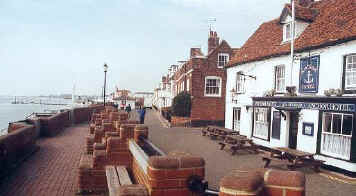
Another reason I was so hugely taken with the novella was its setting. It is set in north Germany in an area called Friesland - which is sited in that small triangle of land at the 'neck' of Denmark and nestling agains the lowlands of the Netherlands. Obviously it has a great deal in common with the Dutch landscape- being low-lying and dyked to protect the land. The fact is, that although haven't visited the area, one day I would very much like to. I grew up in, and still live in an area on the East coast of Britain, that I felt had much in common with Storm's Friesland. We live in a flat tidal landscape, with salt flats and acres of mud exposed at low tide. Our coastline is ringed round with banked sea walls (although nowwhere near as imposing or substantial as Frisian dykes), and the carcasses of Thames barges nestle between the 'islands' of the salt flats. Like Storms Friesland - our horizon is low and flat and our skies are huge and imposing. Our area too has suffered huge flooding at various occasions in history, and foreign wisdom (notably Dutch drainage engineers) was called on by the 18th and 19th century landowners to make their low lying land more profitable and reclaim salt-marsh from the sea for arable land.
I am very attached to this part of Britain, which is unknown and overlooked by most who see our county as an extension of modern London - and forget that our heritage is written in the landscape. By the way - I am speaking about Essex.

 Boudica (hey - there are several spellings and even more pronunciations) was Queen of the Iceni tribe, a celtic tribe which occupied the land quite happily as an independant ally of Rome, in the area that is now Norfolk. On the death of Boudica's husband, the king Prasutagus, the Romans failed to honour an arrangement to leave Boudica and her daughters half the kingdom and instead flogged Boudica and raped her daughters. Understandably this made her a little cross, and her people, allied with the Trinovantes (our Essex celtic tribe) stomped the Romans good and proper. Sadly in the end she was defeated (although not without making a real mess of Roman Britain) and killed herself.